By Fresheather · April 2026 · 5 min read
UK beauty marketing teams in 2026 work across a much sharper content environment than the one we left at the start of the decade. Instagram, Facebook and TikTok are running side by side, each rewarding different content pillars, and the production benchmark for in-feed content keeps rising. Beauty teams that are still relying on hero campaign content with thin always-on cutdowns are watching engagement slip while sharper challenger brands and creator-led players take share.
This post is the working briefing Fresheather uses with beauty brand managers, ecommerce leads and social content owners scoping their 2026 always-on social plan. We have pulled together the statistics that matter, added context for UK beauty specifically, and finished with a decision guide for where to keep work in-house and where an agency partner earns its place.
The State of Beauty on Social Media in 2026
UK beauty is one of the fastest-growing social categories right now, and the data backs that up. TikTok has 26.8 million active users in the UK, with ad reach rising 12.5% between 2024 and 2025, and the average UK user now spends 49 hours 29 minutes per month on the platform. For beauty specifically, TikTok posted 110% content growth in 2025. Beauty-focused LIVE shopping sessions on the platform grew 90% year on year, with more than 6,000 LIVE sessions now running in the UK every day.
The commercial side has followed. TikTok Shop is now the fourth largest beauty retailer in the UK after 60% year-on-year sales growth, and Barclays has named beauty as the standout category for social commerce in the 2026 cycle. For brands that were still treating social as awareness media in 2024, the last twelve months have rewritten the job description.
At the same time, Instagram is not going anywhere. Charlotte Tilbury holds 7.5 million Instagram followers, the highest of any UK beauty brand, and Instagram Reels still deliver the category's strongest direct-to-purchase conversion rates. Beauty-specific Instagram engagement sits at roughly 1.6%, a steady baseline that rewards consistency over volume.
The honest summary: TikTok for discovery and sales, Instagram for conversion, and a supporting cast including YouTube Shorts, Pinterest and LinkedIn for category authority. Beauty brands still running all four channels from the same content file are leaving growth on the table.
TikTok Shop is now the UK's fourth largest beauty retailer, and nearly 40% of UK Gen Z say it is where they discover the beauty products they end up buying.
TikTok: The UK's Beauty Discovery Engine
- TikTok is the number one beauty discovery platform for UK Gen Z. 40% name it as their primary source for finding beauty products, and 77% of Gen Z use TikTok to discover new items across categories.
- Beauty and personal care content on TikTok has a median engagement rate of 9.1%, well above the 4.5% UK platform average across categories.
- TikTok Shop beauty sales rose 60% year on year, making it the UK's fourth largest beauty retailer in 2025 and into 2026.
- LIVE shopping for beauty grew 90% in 2025, with over 6,000 UK LIVE sessions running every day. Smaller challenger brands are using LIVE as a near-zero-CPA launch format.
- The number of active TikTok Shop creators in the UK is up 72% year on year, and hundreds of top performers now build full-time careers off TikTok Shop commission.
- Over 70% of Gen Z beauty purchases are influenced by social, led by TikTok and Instagram, and most UK Gen Z beauty shoppers buy across skincare and beauty multiple times a month.
Instagram and Facebook Content Pillars for Beauty Brands
- Five Instagram content pillars working for beauty in 2025 and 2026: hero product Reels with shopping tags, founder and team voice, ingredient and science explainers, UGC reposts with credit, and seasonal or trend-led carousels. Brands running the full mix hit the 1.6% engagement and 30% follower-reach benchmarks below.
- Four Facebook content pillars still earning attention from UK beauty audiences: long-form community posts, retargeting Reels mirrored from Instagram, Facebook Live launch events tied to TikTok Shop drops, and review-led social proof. BEAUTY BAY leads UK beauty Facebook at 1.5 million fans by running close to this exact mix.
- Instagram Reels deliver roughly 1.3x higher e-commerce conversion than TikTok for beauty, fashion and lifestyle categories, thanks to mature in-app shopping, product tagging and established checkout flows.
- Average reach per Reel for brand accounts sits at around 30% of follower count, more than double carousel or static post reach.
- Charlotte Tilbury holds 7.5 million followers, the largest UK beauty Instagram presence, while BEAUTY BAY leads Facebook at 1.5 million fans. A useful reminder that Facebook and Pinterest still hold meaningful beauty audiences in the UK.
- Instagram beauty engagement averages 1.6%, lower than TikTok but more predictable. Branded series and recurring formats consistently outperform one-off campaign posts.
- YouTube Shorts is now a genuine third pillar for beauty, pulling over 200 billion daily global views and benefitting from YouTube's searchable back catalogue for tutorials, how-tos and routine content.
- Hybrid beauty strategies outperform single-platform ones. Brands running coordinated campaigns across Instagram Reels, Facebook, TikTok and YouTube Shorts reported around 34% higher blended ROAS over the last year compared to single-channel peers.
Format and Creator Trends Worth Planning For
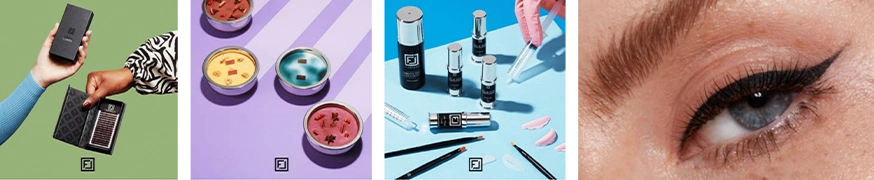
- Tactile, sensory product capture. Pumping, tapping, swatching and texture sounds drive higher completion rates on TikTok and Reels. Sound design is now something to plan for, not something to add at the end.
- Native-feel creator content. 10,000 to 100,000 follower micro-creators deliver 6.8% average engagement in beauty, compared with 1.4% for accounts above 1 million. Size down, not up.
- Educational and routine-led content. Routines, ingredient explainers and skin or hair concern Q&As outperform aspirational hero shots in 2026 beauty feeds.
- Short-form weekly cadence. Brands posting three to five short-form pieces per week on each platform retain the strongest algorithmic reach.
- Sound-led mood content. Music-led mood reels with no voiceover work for category-spanning brand pieces, especially on Reels.
- Stop motion and tactile capture as differentiators. Tactile, frame-by-frame product sequences cut through AI-generated sameness and over-polished campaign content.
In-House vs Agency: How to Decide Where the Work Sits
- Keep in-house: community management, rapid comment and DM responses, day-to-day scheduling, first-party insight reporting, and any content that needs true internal voice (founder posts, team moments, office and event coverage).
- Partner with an agency: production volume, platform-specific creative concepting, stop motion and tactile formats, hero product shoots, UGC programmes that need creator curation, and any work where a consistent visual system is required across every touchpoint.
- The rule of thumb: if the work scales a repeatable system, agency. If it requires same-day brand voice and internal context, in-house. The trap is trying to do full production volume inside a two-person social team.
- Brief your agency partner on the platform, not the asset. "We want to win on TikTok in Q3" produces sharper work than "we need 30 pieces of content". Platform-first briefs now outperform format-first briefs by a wide margin on measurable outcomes.
- Ask for a content system, not a one-off campaign. The UK beauty brands growing share in 2026 are running UGC and creator programmes as ongoing retainers, not ad-hoc projects.
- The smartest 2026 set-up is a small, sharp in-house team running community and always-on posting, and a specialist creative partner handling social-first production and photography. Fresheather builds social content and beauty imagery for UK brands that want both speed and craft. Explore our Social Content and Photography services, or get in touch to discuss your next campaign.